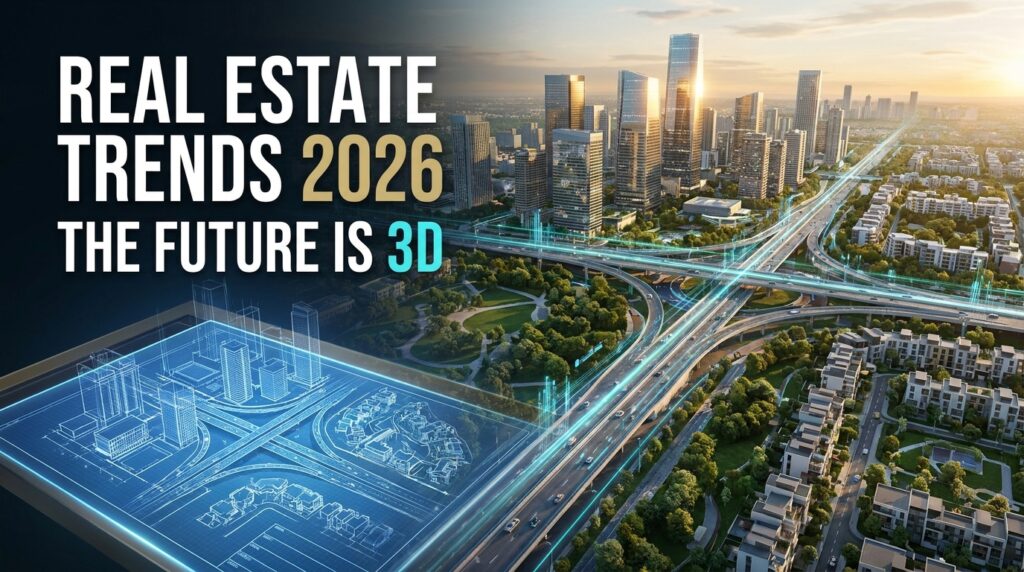
Real Estate Development Trends in 2026: How 3D City Visualization Is Changing the Industry
The real estate industry is entering a new era of development. Cities are expanding, investors are becoming more…


Artificial intelligence is changing more than the technology industry. It is also reshaping the global real estate market.
Behind every AI assistant, cloud computing platform, online service, and large-scale digital application is an enormous network of physical infrastructure. Data centers provide the buildings, computing equipment, cooling systems, electrical infrastructure, and connectivity required to keep these services operating.
As demand for AI computing continues to expand, data center development is attracting significant attention from property developers, infrastructure companies, and institutional investors.
In 2026, data centers are becoming one of the most closely watched categories in commercial real estate.
But what makes these developments different from conventional commercial buildings? Why are investors increasingly interested in digital infrastructure? And what should developers understand before planning a data center project?
Let’s explore the opportunity.
Artificial intelligence requires substantial computing capacity.
Training advanced AI models, operating cloud applications, processing large datasets, and delivering AI-powered services all depend on specialized computing infrastructure.
This infrastructure operates inside purpose-built data centers.
Unlike traditional office buildings or retail properties, data centers require highly specialized facilities designed around technical performance and operational reliability.
As AI adoption expands, companies need more computing capacity, creating demand for additional facilities and suitable development sites.
This is attracting interest from real estate investors who want exposure to the physical infrastructure supporting the digital economy.
The growing interest in data center property is reflected in industry research.
Knight Frank’s September 2026 analysis, The Magnificent Seven, identifies data centers among seven specialized sectors shaping the next phase of commercial real estate investment.
The report highlights growing demand driven by artificial intelligence and digital infrastructure, particularly in the United States, the Nordic countries, and the Middle East.
The other emerging sectors include logistics, living sectors, healthcare and life sciences, hospitality, energy and infrastructure-linked real estate, and high-quality offices.
This reflects an important change in investment thinking.
Commercial real estate is no longer evaluated solely through traditional property categories. Investors are increasingly examining specialized assets connected to technology, energy, demographics, and essential infrastructure.
For developers, this creates opportunities to explore new types of commercial property projects.
Recent industry research provides several important indicators of market activity.
CBRE’s June 2026 Global Data Center Trends report highlights significant inventory growth across major markets during the first quarter.
North America: Inventory across the four largest markets increased by 33% year over year.
Europe: Inventory across the four largest markets increased by 18.9%.
Asia-Pacific: Inventory across Singapore, Tokyo, Hong Kong, and Sydney increased by 13.4%.
Latin America: Inventory across four major markets increased by 41.3%.
These are regional market groupings, not figures representing every country or city.
The report also found exceptionally tight availability in some locations. Northern Virginia recorded a data center vacancy rate of just 0.3%, while Atlanta recorded 1% in Q1 2026.
These figures demonstrate the strong demand and constrained availability in selected established data center markets.
However, development opportunities vary considerably by location. Infrastructure capacity, site availability, construction expenses, regulations, and investment conditions all influence whether a proposed project is viable.
A suitable location is essential for a successful data center project.
Unlike many traditional commercial properties, data centers cannot be developed simply by selecting an attractive piece of land.
The site must meet several technical and geographical requirements.
Data centers require substantial and dependable electrical capacity.
Developers must evaluate available grid capacity, access to substations, potential power upgrades, backup systems, and long-term energy requirements.
In some established markets, electrical infrastructure is becoming a major development constraint.
High-performance data centers need reliable connectivity to telecommunications networks and other digital infrastructure.
Proximity to suitable fiber routes and network infrastructure can influence site selection.
Computing equipment generates significant heat.
Depending on the facility design, developers may need advanced air-cooling systems, liquid-cooling infrastructure, or other specialized cooling solutions.
Water availability, energy consumption, and environmental considerations should be evaluated during planning.
Large-scale facilities may require substantial land for buildings, electrical equipment, cooling systems, access roads, security zones, and future expansion.
A site with sufficient space for phased development can provide greater planning flexibility.
Planning approvals, zoning restrictions, environmental assessments, noise considerations, and community acceptance can affect project timelines.
Developers should evaluate these factors before committing to a site.
Although demand is attracting investment, building data centers involves significant development challenges.
One major issue is construction cost.
In its October 2026 Global Construction Costs Index announcement, JLL reported that construction cost escalation has established a new global baseline of approximately 3% to 6% annually.
The company also forecast a further 3.1% to 4.2% increase in global construction tender prices during 2027.
These figures highlight why developers must carefully evaluate their project budgets and construction assumptions.
Data center projects also require specialized equipment and infrastructure.
Planning mistakes can become expensive when a project reaches later stages.
Developers should therefore combine professional engineering, financial feasibility assessments, and coordinated architectural planning before proceeding with construction.
Another important development is the growing interest in large-scale data center campuses.
Rather than developing only one isolated facility, companies may plan multiple buildings within a coordinated site.
Main data center buildings: Purpose-built facilities containing server halls and supporting technical spaces.
Electrical infrastructure: Substations, transformers, backup generators, and distribution systems.
Cooling infrastructure: Mechanical plant areas and associated equipment.
Access and security: Controlled entrances, internal roads, perimeter security, and service access.
Operational facilities: Maintenance buildings, administrative spaces, and employee facilities.
Future expansion zones: Reserved areas for additional buildings and infrastructure.
This type of development requires detailed masterplanning.
The relationship between the buildings, roads, electrical systems, cooling areas, and surrounding land must be considered together.
A properly coordinated site plan helps communicate how the different components fit into the overall development.
Data center campuses can be technically complex.
Developers may need to explain an extensive site layout containing several buildings, electrical infrastructure, service roads, security zones, and future development areas.
Presenting all this information through conventional drawings alone can make it difficult for non-technical stakeholders to understand the overall project.
This is where professional 3D architectural visualization becomes useful.
A detailed three-dimensional environment can help illustrate the proposed development from different perspectives.
High-quality renders can show proposed data center buildings, structural forms, façades, landscaping, access roads, and surrounding environments.
A complete 3D masterplan can present multiple buildings, infrastructure zones, internal roads, and development boundaries in one cohesive environment.
Aerial animations allow viewers to explore the proposed campus from elevated perspectives and understand its overall scale.
Three-dimensional models can help communicate the spatial arrangement of electrical facilities, cooling areas, parking, service access, and security perimeters, based on approved technical plans.
A professional architectural visualization can make the physical concept of a proposed facility easier to understand during development discussions.
It is important to distinguish visualization from engineering validation. A rendered image does not prove available electrical capacity, cooling performance, structural compliance, or project feasibility. Those require qualified engineering assessments.
Nevertheless, visual communication can be a valuable part of a comprehensive development presentation.
The opportunity is substantial, but the sector is not without risk.
Before starting a project, developers and investors should carefully assess several areas.
Market demand: Identify potential customers, cloud providers, colocation operators, and other sources of demand.
Site suitability: Evaluate land availability, access, zoning, topography, and environmental conditions.
Power availability: Confirm actual grid capacity, connection requirements, upgrade schedules, and associated costs.
Construction feasibility: Review building costs, equipment availability, specialist contractors, and development timelines.
Connectivity: Assess available telecommunications infrastructure and network requirements.
Environmental considerations: Examine energy consumption, cooling requirements, water management, and community impacts.
Financial planning: Prepare realistic capital expenditure, operating cost, financing, and revenue assumptions.
Phased development: Consider whether the campus can be developed in stages without compromising the long-term masterplan.
No single factor determines the success of a data center investment. Its commercial potential depends on the complete relationship between infrastructure, market demand, location, technical feasibility, and financial planning.
The relationship between technology and real estate is becoming increasingly important.
Artificial intelligence, cloud computing, digital services, automation, and data storage require physical facilities that must be located, planned, designed, and constructed.
This is creating opportunities beyond conventional commercial property development.
Data centers are one example, alongside energy infrastructure, advanced logistics facilities, and specialized industrial properties.
However, the next phase of growth will require more than constructing additional buildings.
Successful developments will need reliable infrastructure, responsible resource management, carefully evaluated locations, and detailed project planning.
For developers, understanding the relationship between digital infrastructure and physical real estate will become increasingly important.
Every major development begins with a plan.
Whether it involves a residential community, commercial district, industrial development, or specialized infrastructure campus, presenting the complete vision is an important part of communicating a project.
At ReconHub Studio, we transform client-provided maps, masterplans, architectural blueprints, and development concepts into realistic 3D environments.
Using professional Blender workflows and Unreal Engine-quality rendering, we help developers communicate their proposed projects through detailed and visually engaging presentations.
Have a development site, commercial masterplan, or architectural blueprint?
Let us transform your development plans into an impressive 3D showcase.
Fiverr: Visit our Fiverr profile to discuss your project and request a custom order.
Your project. Their vision. Our visualization.
Data center real estate refers to land, buildings, and facilities developed to house computing equipment, servers, networking systems, power infrastructure, and cooling equipment.
Growing AI adoption, cloud computing demand, and digital infrastructure requirements are increasing demand for specialized data center facilities. Their investment potential depends on location, infrastructure, market demand, and financial feasibility.
Important considerations include reliable electricity, grid connection capacity, fiber connectivity, suitable land, cooling options, environmental conditions, and regulatory approvals.
Yes. Data centers are a specialized category of commercial real estate, often classified as digital infrastructure or operationally critical property.
Yes. Architectural visualization can represent the proposed buildings, campus layout, internal roads, landscaping, infrastructure zones, and surrounding environment using client-provided plans and technical references.
It can help communicate the site layout, building arrangement, overall development concept, expansion areas, and architectural appearance to investors, stakeholders, and project teams.
No. Visualization complements engineering documentation. Electrical, structural, mechanical, cooling, and environmental requirements must be verified by qualified professionals.
Some recommended offers are affiliate links — we may earn a commission at no cost to you. Learn more
The real estate industry is entering a new era of development. Cities are expanding, investors are becoming more…

Modern homes and workspaces often have more electronic devices than available wall outlets.Between laptops, monitors, smartphones, televisions, speakers,…

Keeping a home organised can be challenging when storage space is limited. Kitchen counters become crowded, bathroom products…
We detected a preferred language for your region/browser. You can translate the whole site now or keep English.